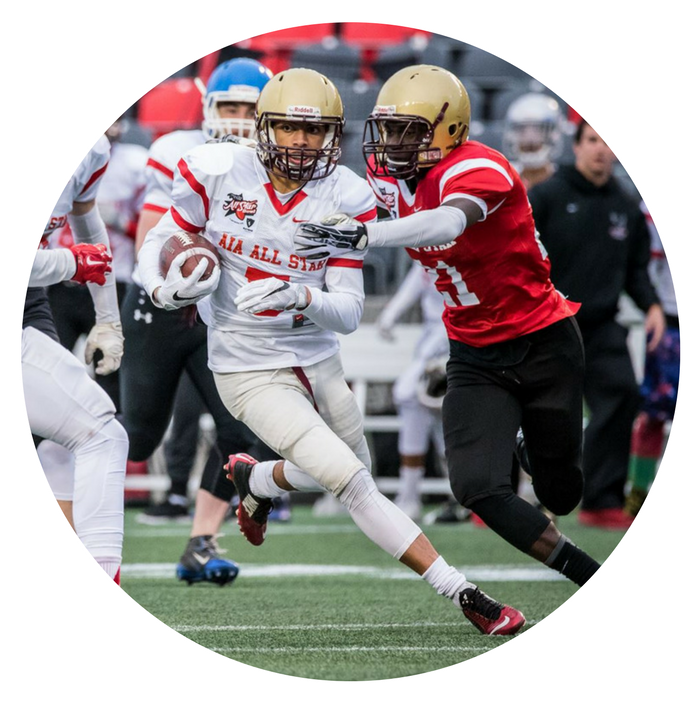

Identity is shaped by all the roles we play. Family member. Friend. Worker. Athlete. Each role has expectations attached to it — preferred behaviours, assumed paths. This worksheet walks you through those roles, one at a time, so you can see how your sense of self has been built.
We have been investigating the idea that our story helps shape our identity (see the feature article). Through the exercise below, take time to explore how your own identity has developed and how play and sport have been part of your story.
Work through the following questions on your own, with a friend, or in a group. Take your time with each one. If it helps, journal your thoughts.
Roles in your family
When experts explain identity, they often mention that it is shaped by the roles you play in your life. That is a good place to start as you try to answer the question "who am I?"
- You have roles in your family — daughter, son, parent, cousin. But you may also be the peacemaker, the loner, the rebel.
- What are all the roles you play in your family?
- How have they helped shape who you are?
Roles in your social circle
- Are you a friend to many or to a few?
- Is there a role you play in your social circle? (Organizer, advice-giver, comedian.)
Roles in your work
- What roles have you played, or are you playing, in various jobs you have had or the career you are pursuing? (Labourer, administrator, supervisor.)
When sport became important
- When did sport begin to become very important in your life?
- Would you say you have taken on the role of the athlete?
- How did that develop, and what does it mean to you?
Roles in your sport culture
- What roles have you played in your sport culture? Hard worker, strategist, specialist, unity-builder, team player, captain, coach, support staff.
Try it without sport
- If a starting point for defining identity is answering the question "who am I?" — could you give the answer without referring to your sport?
- Give it a try.
- Maybe not allowing you to mention sport isn't really fair, since sport is a large and legitimate part of your life. So how soon, how often or how much would you include about your sport when you answer the who am I question?
Preferred, expected, assumed
As you look at the total list of roles you have, can you put into words what each subculture preferred your role to be, the behaviours that are expected in that role, and the path that role assumes is ahead of you? [1] How well have you fit into those templates?
Inside the boundaries, and outside
As you take this time to think about who you are: how much of your self-concept has been shaped by your sport experiences, and how much from beyond the boundaries of your chosen sport? [2]
Keep exploring
- Walk through the play and sport timeline of your life in My Journey Through Play and Sport.
- See what God says about you at every stage of that journey in Identity Truths.
- Return to the feature article.
References
- Carless, D. and K. Douglas, Living, resisting, and playing the part of athlete. Psychology of Sport & Exercise, 2013. 14(5): p. 701–708.
- Miron, P., Role identity and its implications in the athlete's personal development. Timisoara Physical Education & Rehabilitation Journal, 2010. 3(5): p. 7–12.
Dave writes on faith, sport and identity for Athletes in Action.